Sunday, 5 March 2017

Did Harold really take one in the eye?

It is the story that every schoolchild is brought up on (or at least was when I was at school in the distant past); that brave King Harold was killed at the Battle of Hastings by being shot in the eye with an arrow. But did it really happen? Have millions of children been lied to over countless generations in what can only be described as a shocking, shameful conspiracy to cover up the truth? (OK - i may be over-egging the pudding a bit there but the arrow in the eye story could perhaps help to mask events that were altogether less palatable to the reputation of the new king, William I.

But look at the evidence, I hear you say. The Bayeux Tapestry clearly shows him standing there, clutching an arrow that is protruding from his skull under the very words "Harold rex interfectus est" (which as every school child also knows from their Latin lessons  means "King Harold was killed"). The head of the figure with the arrow in his eye even bisects the word, 'Harold', surely leaving no doubt as to this being supposed to represent the king. What could be clearer? On top of this there are a number of chroniclers who also make reference to the arrow in the eye story. William of Malmesbury, writing in the 12th century, states "his brain was pierced by an arrow", and Henry of Huntingdon (in the same era) backs this up by saying: "The whole shower sent by the archers fell around King Harold and he himself sank to the ground, struck in the eye." With such evidence in front of us, why then do some suggest this is not how things played out in truth?

Well, let's look first at the Tapestry. Just which figure is supposed to be Harold? Looking at the picture above, there are really three options: the man to the left, clutching the arrow; the man to the right who has just been cut down by the mounted soldier; or they are both meant to be the same person (such a construct - showing the same person within consecutive 'frames' of the storyboard is used elsewhere, but it is perhaps doubtful here as - in the space of a couple of inches he has lost his shield and gained a battle-axe).

There is also doubt over whether the first figure is even clutching an arrow! There are some who contend that the significant restorations undertaken in the 19th century may even have altered the whole sense of the Tapestry. It is suggested that the figure was - in the original - in fact holding a spear ready to launch at the enemy. And then, finally, even if we accept that it was an arrow that was depicted, how do we know that this represents what actually happened on the day? There are other fabrications (ooh - do you see what i did there?) contained in what is essentially a piece of propaganda rather than a journalistic account of the battle.

The fact is that the Tapestry is the only (near) contemporary source to refer to the arrow in the eye story. The Chroniclers referred to above were writing well into the next century and are not, therefore, first-hand accounts. There are four other contemporary accounts that make no mention of it at all. Two (the Anglo-Saxon Chronicle and William of Jumieges) can be discounted because their accounts are brief and thus that level of detail would not be expected. The accounts held in the other two (the Carmen de Hastingae [song of Hastings] and William of Poitiers) are all the more remarkable.

William offers a long and detailed account of the battle and yet omits to mention how Harold met his end at all. Is it possible that he did not know? Or is it more likely that he had read the account in the Carmen and thought it best not to mention it - him being William the Conqueror's man, it would not do to cast a poor light over his master.

So what does the Carmen say? It states that, late on in the day, William spotted Harold, laying about with his sword, casting down all and sundry. The Duke gathered a small group of knights and charged. They succeeded in killing the king and then the manuscript goes on to give the gory details of the injuries inflicted: pierced with a lance, beheaded with a sword and disembowelled with a spear. It goes on to say that his 'thigh' was hacked off and carried away some distance (Note - for thigh, read manhood, dick etc.).

So why is this account not more famous than, or at least as famous as the old arrow in the eye shtick? Some have suggested that it can't be true because if William had been directly involved in the death of Harold it would have been shouted from the rooftops as a great feat of arms and, thus, the fact that this is not the case is proof that it didn't happen. Fake news was a thing even then, it seems.

Perhaps more telling is the fact that William of Poitiers, the king's own biographer, is silent. He neither confirms or denies the Carmen's account and that silence is deafening. His aim was to present William as a righteous and merciful king and having him involved in the hacking to death and subsequent mutilation of an annointed king (usurper or otherwise) would not help the cause in any way. His failure to deal with the subject could therefore be held to actually strengthen the Carmen's claim to be the one true account. It should also be remembered that the author of the Carmen (one Guy d'Amiens) was supposedly a close associate of the knights who were named as Harold's killers.

In summary, I guess - as with most things from this time - we may never know for certain exactly what happened. For me, however, we know that the Normans did loose a prodigious number of arrows during the battle, so there is a fair chance that one or more struck the king. We also know that William was in a very tense situation; he had this one chance to seize the throne and so the opportunity to kill Harold outright rather than risk him slip away into the gathering gloom was, perhaps, too good to miss. Finally, history - as ever - is often written by the victors, and I am sure they would not be above a little bit of airbrushing to protect their man's reputation.

Sunday, 29 January 2017

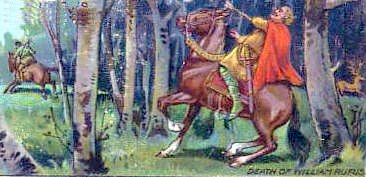
When brothers won't share - the curious case of William Rufus (ruled 1087-1100)


That William II - known as Rufus because of either his red-faced complexion or his propensity to anger quickly - succeeded his father to the throne of England, despite being William the Conqueror's third son, tells a story of its own and gives some insight into the troubles that lay ahead.

At his death in September 1087, William the Conqueror had ruled Normandy for, in effect if not in fact, over fifty years and his family had held it for considerably longer. England, however, had only been added to his possessions a mere twenty-one years previously. Whether we like it or not, England, as wealthy as it might have been at the time, was not the most not the most prized asset up for grabs.

William had three surviving sons amongst whom to divide his estate; a fourth, Richard (the second born son), had - spookily enough - been killed in a hunting accident in the New Forest around 1075. The eldest son, Robert (known as Curthose on account of the fact that he was a bit of a short-arse and thus his leggings were not the longest) was bequeathed the duchy of Normandy as was in keeping with the rules of primo-geniture (first born) in that land.

No doubt in an attempt to be even handed between the three sons, perhaps to try and stave off future conflict, William then gave England to his third son, William Rufus. The fourth son, Henry (keep him in mind for later), was given no land but instead inherited 5,000 pounds of silver to ease the pain.

Despite these best intentions, this settlement caused turmoil both amongst the sons and the barons alike, many of whom owned estates on both sides of the channel and were thus caught between the proverbial rock and a hard place. When, rather than if, Robert and William were to fall out, they would be forced to pick sides and therefore would risk losing their estates if they chose wrong.

That the brothers were not best of friends is well illustrated from an incident that supposedly took place around 1077/78 when William would have been around 17 years old. He and his brother, Henry, had been playing dice when - growing bored - they cooked up a prank to play on Robert. You can imagine that the eldest brother might have had a "considerably better than you" attitude to his younger siblings which no doubt made them feel the need to take him down a peg or two. The details are not entirely clear but it seems they waited until he was passing below the gallery on which they stood and then either emptied the contents of a chamber pot on his head or urinated on him. Either way it would not have been particularly pleasant.

But hey! We've all done that to our older brothers, right?  Boys will be boys and all that? Robert didn't find it funny, though, and laid into his brothers so furiously that eventually William senior had to break it up. You can imagine how he must have been annoyed to be distracted from his work: "Don't make me come in there! You'll feel the back of my hand if I do." etc etc.

Anyway, sure enough, it was not long after the father's death that the problems began. A number of nobles felt that the best outcome all round would be if the two lands were united under one of the brothers which, combined with the natural sense of conflict between the three men, led to a number of plots over the succeeding years. Added to this mix was the character of the men themselves. Robert appeared to be a thoroughly ineffectual ruler, unwilling to stand up to the unruly excesses of the barons in Normandy. William, on the other hand, while he could be wise and decisive, was interested in little other than hunting and military exploits. Chroniclers of the time described him as vain, capricious, ill-tempered, blasphemous and contemptuous of religion. His apparent cruelty and greed was enough to see many nobles side with Robert in the first rebellion of his reign in the late 1080s. Robert - being next to useless, however - failed to capitalise on what could have been a golden opportunity to combine both lands by not coming to England to lead the uprising. It was relatively simple, therefore, for William Rufus to crush the rebels before too much longer.

With a free hand, William was now able to use his position to exploit his subjects and abuse his power as much as he liked. Exorbitant inheritance taxes were levied, heavy court fines were imposed and enforced rigorously. He saved the church for special attention, seeing them as little more than a huge corporation to be taxed to the hilt. He deliberately left empty bishoprics vacant for ages so that he could claim the unused salary. He clearly had no fear of the threatened eternal damnation for his actions.

Whilst he was not the best of chaps, it should be remembered that chroniclers tended to be religious men and you annoyed them at your peril as they would have the last laugh in that it was they who got to write the history by which you would be remembered. The finger was also pointed firmly at his morals. He never married and there was no mention of lovers or bastard offspring and it was claimed that he often engaged in sodomy. To the modern observer, it is pretty clear that he king was homosexual. No big deal, right? But at the time this was an affront to God and a threat to the kingdom as one of the key duties of the king was to secure the succession but providing an heir. Interestingly, even as recently as the early 1950s a text book I have described him as "one of the worst kings in respect of his morals." Our more enlightened times are a thing of the relatively recent past and are as yet still not that well-established in all corners of the world.

Enough of that! Let's get to the subject of William's curious death while hunting. It's fair to say that, since 1066, a decent number of kings have died violently in one way or another. But once you rule out battle (Richard I and III), execution (Charles I) and deposition (Edward II, Richard II, Henry VI and Edward V), then William Rufus seems to be the only case I can call to mind of a king of England who was killed by accident - or was he? Are we dealing with a fatal accident or a deadly conspiracy?

On the day in question, William was in fine fettle; he loved hunting above all else. In terms of his choice of royal day-out it was the best larks evs. Also in his party were a number of other nobles, key amongst whom were: his younger brother, Henry (Aha! He's back!), the brothers Gilbert and Roger de Clare and Walter Tirel who was Lord of Poix in Ponthieu and brother-in-law to the de Clares. Shortly before they set off, a letter from the Abbot of Gloucester was delivered which warned of a monk who'd had a vision of the king's death. William, however, scoffed at the nonsensical "dreams of snoring monks" and rode off into the forest.

As the story goes, the party became separated as the chase got underway, Rufus and Tirel finding themselves alone. Startled by a stag that came out of nowhere, Tirel supposedly loosed an arrow which missed, deflected off an oak tree and struck the king in his chest, piercing his lung. What happened next is what has given rise to claims of a conspiracy. First of all, Tirel immediately fled overseas. Was this because he was worried he might be punished for his negligence or rather because he had been paid to carry out the evil deed and needed to make himself scarce? You ain't seen me, right?  Either way, he was supposed to be an accomplished bowman so it is doubtful that he would be so rash as to take such a risky shot. That said, hunting accidents were not uncommon; remember William's own brother had died twenty-five years earlier in the same forest.

More telling, though, is the behaviour of Henry. Rather than care for his wounded brother or oversee the transport of his body to nearby Winchester, he chose instead to abandon Rufus and ride with all speed to Winchester where he seized the treasury. A day later he had himself elected king and was crowned two days later in Westminster Abbey before either Archbishop could arrive. Why the haste if this was not a premeditated plan? Seizing the treasury so quickly is particularly telling as possession of the royal coffers effectively conferred power onto the person who held them.

Once Henry was king (Henry I for those that worry about such things), he was at pains to lavish favour on the de Clare brothers. Perhaps this was reward for their support in the conspiracy?

So what of William Rufus? His body lay abandoned while everyone else rushed off to secure their positions for whatever reason. He was eventually found by a charcoal burner named Purkiss, who unceremoniously dumped the body in the back of his cart and took it to Winchester where the king was hastily buried beneath the tower. That the tower then collapsed a few years later was taken as a sign - by the church - that he was ill-favoured by God due to the evil actions during his reign. His death, to them, was quite simply an act of God and nothing more than he deserved.

Sunday, 8 January 2017

The White Ship: a 12th century succession crisis.

It is one of the greatest naval disasters in the history of these British Isles but one that few people have heard ever of.  One seemingly small event on a foul day in November 1120 was to cause a crisis in the royal succession and lead to a civil war that was comparable in impact to its more famous successors in the fifteenth and seventeenth centuries.  

As the Chronicler, William of Malmesbury wrote: ‘No ship ever brought so much misery to England’.

So what happened? The king at the time – Henry I, fourth son of William the Conqueror – had been in Normandy to deal with a dispute over the title to the Duchy that had been raging with Louis VI of France since 1115. Peace had finally been achieved with the help of Pope Callixtus II and now Henry was preparing to sail back to England with his only son and heir, William Adelin.

(NB. Regular readers of this blog may recognise a similarity with the Saxon word Aetheling, meaning prince of the royal dynasty, as in Edgar Aetheling who was briefly acclaimed King by the Saxons after the death of Harold II at Hastings. Adelin is the Norman spelling of the word and an attempt to show continuity with the former Saxon rulers; a union of old and new, if you will.)

Henry and William arrived at the port of Barfleur where they were met by a ship’s captain, Thomas FitzStephen, who offered his newly refitted, state of the art vessel – the White Ship – to convey the king back to England. Thomas was a man of some renown as he was the son of Stephen FitzAirard who had captained the Mora in 1066; the ship that had carried Duke William to England to launch his invasion.

Despite these impressive credentials, King Henry demurred. He had already made his travel plans and no doubt he preferred his trusty old ship rather than any new-fangled, modern nonsense. Nonetheless, he did allow his son and his retinue (including two of the king’s illegitimate children: Robert of Lincoln and Matilda FitzRoy) to avail themselves of Thomas FitzStephen’s offer.
That is when the drinking started. William was 17 at the time and, like many teenagers suddenly free of the shackles of an overbearing father, he saw the opportunity for a party with his mates. The wine flowed in copious quantities and by the time the ship set sail that night, over 300 people were on board, most of whom would have been roaring drunk; including the ship’s captain.

Whether it was William himself or one of his friends that put him up to it is not known, but – full of drunken bravado – they ordered the captain to show them what the ship could do, challenging him to overtake his father (who had left port several hours earlier) and to reach England before him. No doubt William pictured himself standing smugly at the docks in Southampton or wherever, casually waving as his father eventually arrived, shouting “What took you so long?”

However, the harbour of Barfleur is difficult to navigate at the best of times but in the dark and with the crew several sheets to the wind, it was a recipe for disaster. In order to gain time on the rest of the royal fleet, they dispensed with following the safe route and instead went full pelt in the most direct route possible. Disaster struck not far out to sea, when the hull struck a submerged rock, ripping a huge gash in the timbers.


It would appear that not everyone was completely trousered, however, as members of William’s household did manage to bundle the prince into a small dinghy and get him away from the floundering ship. Everything might have been well were it not for the fact that William was said to have heard the cries of his half-sister who was still on the White Ship. William gallantly ordered the dinghy back to rescue her and it is ironic that such a noble action was to seal his fate. By now there were so many people in the freezing waters of the Channel that there was a mad scramble to reach the dinghy, the result of which was that the little boat was swamped. It capsized and sank without trace, taking the heir to the throne of England and Normandy with it. For months after, finely dressed bodies were washed up all along the shoreline, but no race was ever found of William Adelin.

Impact
So why did the loss of this one ship have such a huge impact? Well, never was the phrase ‘Heir and a spare’ more apt. Despite having numerous illegitimate children, William was Henry’s only surviving male heir. His only other legitimate offspring was his daughter, Mathilda (also sometimes known as Maud), and in these unenlightened times, no one was quite ready for England to be ruled by a woman.

The death of William therefore caused a succession crisis. Although Henry married again and was to reign for another 15 years, he did not produce any more legitimate children. On his death in 1135, therefore, England was plunged into a period of civil war – known as the Anarchy – that was not fully resolved until Mathilda’s son, Henry II, acceded in 1154 (him of Thomas a Becket fame).

Henry I did nominate his daughter as his successor and made his nobles swear an oath of allegiance to her but, with him gone, they weren’t inclined to make good on that vow. Mathilda, together with her husband, Geoffrey of Anjou, tried to take the throne as planned but they were met with resistance from the Norman barons who, instead, favoured her cousin (and Henry I’s nephew), Stephen of Blois, who was to become King Stephen.


Mathilda did actually defeat and capture Stephen at the Battle of Lincoln in 1141 but her attempted coronation at Westminster Abbey collapsed in the face of bitter protests from the London crowds. Then, as now, there were those who would rather anyone other than a woman be in charge.

Thereafter an uneasy stalemate ensued with many twists and turns until a point was reached whereby the future Henry II acknowledged Stephen as the rightful king was in return was adopted as Stephen’s son and successor. Although Mathilda had failed to become Queen in her own right, she had at least managed to secure the succession for her son. A great grandson of William the Conqueror would carry on the line.

Friday, 16 December 2016

Decimation - not as bad as you might think?


Decimation - if you were to look it up in the dictionary you might find words to the effect of "to destroy or kill a large proportion of  (e.g. a plague decimated the population)".  In the Thesaurus you will find synonyms such as 'annihilation', ' cataclysm' or 'devastation'; all of which sounds pretty apocalyptic. But was it always this way? Has modern usage assigned a meaning that is far bigger than the original intent?

Well - the short answer is "yes", but when was there ever any fun in giving a short answer when you have a long one to hand, as it were. 

The word decimation - as you might not be surprised to learn - originates from the Latin for ten (i.e. decem). In its original form, decimation was a form of punishment used to instill discipline within the Roman Army from the fifth century BC until the early Imperial times of the first century AD, and which even made the odd appearance in much later times - but more of that later.

So what was decimation all about? Well, in essence it was a spectacularly brutal exercise that must have been an incredibly effective deterrent to any unit that was considering desertion in the heat of battle or mutiny against their commanding officers.

In summary, the procedure - once enacted - was as follows: a cohort (typically around 480 men) was divided into groups of ten. Each group then drew lots with the loser then being executed by the other nine - usually by means of stoning or clubbing to death. 

Watching someone being executed by means of a hangman or similar must have been bad enough, but actually having to do the killing yourself must have been horrendous. The poor sod who drew the short straw might well be your best friend - someone with whom you had joined up many years before, trained with, fought with, perhaps even saved your life on occasion. At the very least it would be someone you shared a tent or barracks-room with. Someone with whom you had forged an incredibly strong bond of trust and loyalty. And now you had to crush his skull with a rock. 

For the rest of the unit, that was not the end of the matter, though their fate was by no means as bad. They were made to live off barley instead of wheat rations and forced to camp outside the walls of the fort for a few days which, if on campaign, must have carried its own dangers.

I can well imagine that the threat of this punishment must have gone a long way to keeping legionaries in line when it came to facing down overwhelming odds in battle. Better to fight and die with honour than live with disgrace and the threat of decimation. 

How often was it used? Not very, in a nutshell. The earliest recorded instance occurred in 471 BC where, after the army had been scattered by the Volsci tribe, the consul of Rome ordered that the officers who had thrown away their weapons would be whipped and beheaded and that the rank and file would be decimated. 

Another example occurred during the Third Servile War in 71 BC (cue cries of "I'm Spartacus and so's my wife".... er.... hang on). Following early victories for Kirk Douglas' slave army, the Roman Commander - Marcus Licinius Crassus - dished out the punishment to which a number of contemporary historians then attributed his subsequent success. Hollywood left that bit out of the film, though I don't know why as it would have added to the drama quite nicely.

Although the practice was eventually outlawed in the later Roman Empire, there have been a few recorded instances in more recent times. For example, in 1642 during the Thirty Years' War, Colonel Madlon's cavalry regiment (of the Holy Roman Empire) fled the Battle of Breitenfeld (near Leipzig) without a shot being fired. Afterwards the commander, Arch-Duke Leopold of Austria, erased the regiment from official lists, condemned the officers to be beheaded and 90 of the the soldiers were decimated with the survivors being discharged from the army.

So whilst decimation only really meant that 1 in 10 were actually killed, the impact on those involved must have felt pretty cataclysmic all the same. 


Saturday, 12 November 2016

Operation Anthropoid - the assassination of Reinhard Heydrich: my small tribute.

In my novel - To the Devil His Due - I tell the fictional story of a British attempt to assassinate Adolf Hitler during World War II. The two protagonists are foreign nationals, one Dutch, the other Czech, who have both fled their homeland to escape the Nazi occupation. 

In choosing the name of the Czech agent - Jan Kubcek - I was quietly - but very deliberately - doffing my cap to the memory of two very brave men who carried out the successful assassination of Obergruppenfuhrer Reinhard Heydrich on the 27th of May 1942. Those two men were Jozef Gabcik and Jan Kubis - the conflation of their surnames giving me Kubcek (well - approximately). I even went so far as to have Kubcek say that he had been scheduled to go on the operation to kill Heydrich but had broken his ankle during a practice parachute jump, and that the man who had replaced him had been the one who had ultimately cracked under pressure to reveal the whereabouts of the agents after the event. 


Who was Reinhard Heydrich and why did he have to die? 
Effectively third in command of the Nazi hierarchy, Heydrich had been appointed as Reichsprotektor of Bohemia and Moravia in September 1941. In the months that followed he became known as the Butcher of Prague as he rounded up more than 5,000 resistance leaders and members of the intelligentsia, many of whom were executed out of hand.  At the same time he drove massive improvements in production by rewarding workers who exceeded targets and punishing those that didn't. The German military machine relied heavily on the output of the Czech weapons and munitions factories to feed their Eastern Front campaign.

Meanwhile the leader of the Czech government in exile (based in London) - Edward Benes - grew increasingly concerned about the gradual assimilation of his country under Nazi rule. As far as he was concerned, bold and unequivocal action was needed. He therefore authorised a scheme, code-named Anthropoid, whose objective was to insert two members of the Free Czech Army (specially trained by Britain's Special Operations Executive (SOE)) into Prague with orders to kill Heydrich.

Eventually, on 28 December 1941, Kubis and Gabcik parachuted into Czechoslovakia armed with sten guns and anti-tank grenades. Gabcik injured his foot on landing and it was two months before they were able to move into Prague to begin planning the assassination. They soon worked out that the most suitable option was to attack Heydrich as he made his daily commute from his home in the suburbs to Hradcany Castle where the Nazis had their headquarters. Whether supremely confident or supremely stupid, Heydrich used the same route every day and had no escort other than his driver. Gabcik and Kubis established that there was a point on the journey where the car had to slow to negotiate a 120 degree turn - that would be the spot where they would launch the attack.

On the day, however, not everything went to plan. 
As the car slowed, Gabcik stepped out in front to open fire but his sten gun (notoriously unreliable) jammed. At this point Heydrich made the mistake that would see him killed. He ordered the car to stop and he stood up to fire back at the fleeing agent. At this point, Kubis threw a grenade which exploded beneath the car, showering both men with shrapnel. Heydrick stepped out of the car to get a better aim with his pistol but immediately collapsed, blood spurting from a wound in his side. 

Heydrich did not die of his wounds immediately. Indeed, it seemed at first that he would make a full recovery once he had been operated on. He was actually sitting up in bed at midday on 3rd June when he suddenly went into shock, lapsing into a coma before dying the next morning at 04.30. Blood poisoning caused by fragments of the car upholstery was the most likely cause of death. 

The agents made good their escape but were unable to get out of Prague due to the intensity of the manhunt to find them. Moving from house to house they were eventually taken to the crypt of the Church of St Cyril and Methodius. Pressure was, however, growing. Over 600 people were executed in the immediate aftermath and thousands more arrested on suspicion of aiding the agents. Ultimately one of the wider network of agents cracked and revealed the location of a number of safe houses. One of which was owned by Marie Moravec who had sheltered the agents on their arrival in Prague. 

Marie committed suicide before the Nazis could take her but they did manage to capture her teenage son. He held out for as long as he could but broke when presented with the severed head of his mother, floating in a fish tank. Soon after, 750 SS troops surrounded the church on the morning of 18 June. The ensuing battle lasted for 2 hours before the 7 agents in the crypt (including Kubis and Gabcik) either succumbed to their wounds or committed suicide.


Worse was to follow. So enraged was the Fuhrer that he order massive reprisals the scale of which was beyond belief. The tiny town of Lidice, 30 miles from Prague, was razed to the ground and simply ceased to exist after the Nazis bulldozed the town, removed all the rubble and planted grain instead. Every single man (over 200) was shot, the women sent to Ravensbruck concentration camp and the children either placed with SS families for re-education or were themselves sent to concentration camps too. 


Days later another town, Lezaky, met a similar fate. All 33 adults were shot and 11 of the 13 children died in concentration camps. Just two girls were spared, being selected for Germanisation. Ultimately they survived the war and were able to return to their families.In Prague itself, a further 5,000 or more civilians were slaughtered and many more sent to camps. The Nazis had sent a brutal message: the price of resistance was heavy. 

Sunday, 30 October 2016

The Star-Spangled Banner - a little piece of Britain

As events across the pond focus on the forthcoming presidential election (and no, I’m not going to get into that, other than to say from a population of over 300 million, surely they could find two better candidates than this…?), I thought I’d digress from matters Anglo-Saxon to something a little more recent; the origin of the Star-Spangled Banner, the song that became the national anthem of the United States of America in 1931.

The anthem traces its origins back to the – somewhat unimaginatively named – War of 1812 which was fought between the USA and the United Kingdom from June 1812 to February 1815. The war itself was a bit of a damp squib as far as the UK was concerned as its major focus at the time was the war to defeat Napoleon in Western Europe. The Americas - and especially the US - however, quite naturally saw the conflict as rather more significant.

It was the United States that declared war; the first time it had done so in its history (all 30-odd years of it at that time). Overall the war achieved little with the British electing, for the most part, to follow a defensive strategy as most of its man-power was tied up with events in Portugal, Spain and France.

The war is, however, notable for at least two events. First the so-called burning of the White House in August 1814. Well, I say the White House, but it was actually known as the Presidential Palace at the time. The Americans were quite rightly aggrieved by this action and it is often remembered today. 

What is less well remembered however is (and note, this falls squarely into the camp of ‘two-wrongs-doth-not-a-right-make’) that this was in itself seen by the British as revenge for the burning of the government buildings in York (the capital of the British province of Upper Canada) by the Americans the previous year. The other notable event was what became the inspiration for the poem which, in time, became the American National Anthem; the bombardment of Fort McHenry in Baltimore.

A few weeks after the burning of Washington, the British army and navy moved 40 miles north west to capture Baltimore, a busy port and a base for American privateers. They launched a combined assault by land and water against well-prepared and heavily fortified American defences. The navy was equipped with the latest technology – called Congreve rockets – which had a longer range than the American shore batteries. This allowed them to stand off, out of range of the American cannon, and bombard the fort with relative impunity. Although there were actually relatively few casualties and little damage down to the fort, the bombardment was nonetheless heavy and spectacular, lasting for the best part of 25 hours.

It was during this time that a lawyer, Francis Scott Key, was inspire to write his, now famous, poem: ‘Defence of Fort M’Henry’. As night fell during the bombardment, the light created by the exploding rockets and bombs served to light up the American flag that was still flying over the fort.  As he and his companions retired for the night, they were left to wonder whether it would still be there in the morning.

When morning came and Key saw that the flag still flew defiantly, he wrote his poem on the back of a letter that he had kept in his pocket. The first stanza eloquently sums up the sense of pride that Key must have felt as he awoke to see that the fort still held against the British onslaught.

O say can you see, by the dawn's early light,
What so proudly we hailed at the twilight's last gleaming,
Whose broad stripes and bright stars through the perilous fight,
O'er the ramparts we watched, were so gallantly streaming?
And the rockets' red glare, the bombs bursting in air,
Gave proof through the night that our flag was still there;
O say does that star-spangled banner yet wave
O'er the land of the free and the home of the brave?

Key gave the poem to his brother-in-law, Judge Joseph H Nicholson, who realised that the words fit rather well with a melody that was popular at the time; ‘The Anacreontic  Song’. In a nice little twist of irony, this song, the basis of the American National Anthem, had been composed by an Englishman – John Stafford Smith – and was the official song of the Anacreontic Society, a gentlemen’s club of amateur musicians which met in London.

The original manuscript can still be seen in Maryland Historical Society on Baltimore.


Sunday, 9 October 2016

Duke William: a Bastard in life and death.

It must have been the event of the year, the one place to be seen in 1087 if you were anyone: the funeral of William, King of England and Duke of Normandy.

William was 59 when he died by when - much like one of his more famous descendants, Henry VIII - he was no longer the fine figure of a man he had been in his youth. Rather, he had become something of a fat bastard, or - as William of Malmesbury (a 12th century English chronicler) rather more eloquently puts it in his Gesta Regum Anglorum - he had become "very corpulent". All that dining on fine French cuisine and good old-fashioned English fare had taken its toll. 

Despite this, before his death he was still putting it about quite a bit, as it were. A key aspect of early medieval kingship was the need to see and be seen. A lot of your authority came from showing yourself to your people and leading them in all manner of military exploits. It was during one such exploit that he met his end. Not shot by an arrow, run through by a spear or hacked down by a sword, but rather he hurt himself while riding his horse in the battle of Mantes in July 1087. 

Well, to be fair, it seems as though the horse must have bolted or been startled - probably protesting at the immense weight it was having to carry - with the result that William was projected violently forward, rupturing his "internal organs" on the protruding pommel of his saddle. He returned to his capital, Rouen, but failed to recover and passed away five weeks later on 9th September.

Arrangements were made for the funeral to take place at the Abbaye-aux-Hommes (which William himself had founded in Caen) and it was there that William left his final mark on the world, though one which he would probably rather have avoided. 

During the service, it was discovered that his vast, bloated body was too big to fit into the stone sarcophagus. You can imagine the panic among the assembled monks. What on earth are we going to do? Everyone's watching! This is so embarrassing! 

Then one bright spark no doubt pointed to the most junior novice and ordered him to 'encourage' the body into the sarcophagus. After some pushing and shoving, the inevitable happened; the bloated stomach burst open. There must have been guts and gunk all over the place. I have a horrible feeling, also, that the poor fellow who had picked the short straw must have ended up almost elbow deep in royal, rotting intestines. It can't have been pleasant. 

Another chronicler, Orderic Vitalis, tells us that the stench was so great that even the frankincense and various other holy spices in the abbey could not take the edge off it. It was so bad that the officiating monks had to rush through the remainder of the proceedings as quick as they could so they could get the hell out of there. A rumour that the last monk to leave the abbey was heard to remark "I'd leave that for five minutes if I were you" cannot, unfortunately, be verified.