The Battle of Lincoln recently celebrated its 800th anniversary but, unlike some other major battles such as Agincourt, Waterloo, Hastings, The Somme, I'd wager that very few people outside the eclectic world of the history nerd are even aware of it. And yet, for all that, it had the potential to be a massive game-changer in the history of this island.
Perhaps it is overshadowed by the event that most school children know which took place two years earlier close to the banks of the Thames and not far from Windsor, namely the signing of the Magna Carta by King John at Runnymede. It is from here, and the earlier events of John's reign, that we can see the causes of the battle that came a year after John's death in 1216.
As an aside, to continue what seems to be a fairly common theme of this blog, John died a horrible, bottom-related death. He contracted dysentery whilst on campaign and suffered what must have been a humiliating and painful demise by, quite literally, shitting himself to death at Newark Castle in October 1216. However bad a king he may have been, you wouldn't wish that on your worst enemy.
Anyway, back to the story. What had once been a vast domain stretching across England and France under his predecessors, had - as a result of John's mismanagement and ill-advised policies - dwindled to control over largely just England. Almost the last overseas possessions, Normandy - the original ducal lands from which our Norman dynasty had hailed - had been lost in 1204. Understandably many of John's barons were particularly dischuffed by this turn of events, not least because they had held considerable estates on both sides of the channel and had thus lost significant income and wealth, not to mention the loss of prestige, which resulted in King John acquiring the nickname, Lackland (those medieval comedians at it again there).
Due to this and John's own cruel and vindictive personality, a good two-thirds of the barons had turned against their King. Matters were temporarily patched up by the issuing of the Magna Carta in 1215. (In this context I always tend to see this great bastion of English civil law as actually being for the barons in the first instance rather than being an early Bill of Rights for the common man. That there were clauses in there which protected Johnny Farmer is all well and good, but the fact is - for me - protecting the people who made money for the Barons was also going to benefit them. That you could not take away a man's plough or convict him without trial meant that the workers were safe from false accusations and could carry on working for their lord until proven guilty in a court of law. A huge simplification - but you get the point).
Oops - I have digressed again. So Magna Carta gets issued and is rescinded soon after (something else that might not be widely known). Indeed one of the main reasons the Carta is so well known today is largely due to it being re-issued several times, firstly by John's son - Henry III - in 1217. Anyway, John' reneging on the deal tips the Barons over the edge and so we have civil war.
Into this mess steps Louis, the heir to the French throne. The Capetian dynasty of France was the arch-rival of the Angevin (i.e. from Anjou) rulers of England. However, alliances sealed by marriages in the 12th century had resulted in Louis having a claim (albeit a weak one) to the English throne. The disaffection of a sizeable proportion of the English barons gave him the opportunity to cause mischief; an opportunity that he was not going to pass up. So it was that Louis landed in Kent in May 1216 at the head of a significant French invasion force.
Things went well for Louis and, by the time of John's death five months later, it looked as if there was a very good chance that England could fall to him. John's successor, Henry, was only 9 years old when he became king which made him extremely vulnerable and almost wholly dependent on the men that were charged with his care by his father. It was here, however, that John did something right for once. The men he set around his son were both capable and effective, and it is largely down to them that Henry not only survived, but went on to rule for over 50 years.
Key among these men was William Marshal, Earl of Pembroke, often described, with some justification, as the greatest knight who ever lived. Alongside him were Peter des Roches, the bishop of Winchester who was not scared of a good dust-up and Faulkes de Breaute who - as one of John's cronies - had a reputation for brutality but who was, nonetheless, a capable military commander. In addition, Henry had the backing of the Pope as he was seen to be the legitimate ruler of England and because John - in another all-to-rare sensible move - had submitted to the Pope's authority in 1213.
The new government began to take steps to establish its presence: a new centre of government was established in Bristol (much of the east and north of the country, including London, was lost to the crown at this time) and the Magna Carta (revised in places) was reissued. On its own, however, his was not enough. a quick and decisive victory was needed against Louis and his rebel supporters. The crown did not have the finances or manpower to wage a protracted campaign. The opportunity for such a victory came in May 1217 at Lincoln.
The city stood as one of the few royalist strongholds to resist the invader in the east of the country. A force comprising French troops and northern rebels had been besieging it for some time but had only managed to breach the outer city walls; the castle itself stood firm under the control of Lady Nicholaa de la Haye. Louis then decided to make a bold move to sweep up any remaining resistance in the eastern half of England before pushing west to take the rest of the country. To achieve this he divided his force in two, sending half to take Dover and the other half to Lincoln.
Whilst this was a grave threat to the royalist cause, William Marshal also saw it as a great opportunity to land a significant blow for Henry against a weakened rebel force. The knight - who was around 70 years old - used all of his knowledge and experience to good effect. Rather than take the direct route from Newark to Lincoln, he looped around from the west to approach the city from the north. This was key as the main southern approach to the city would have resulted in the royal forces having to fight their way across a defended bridge and then up a steep hill to the castle. If you have been to Lincoln you will be aware of this hill that divides the upper and lower town; I think the road that leads up to the castle is even called 'Steep Hill Road' - short and to the point.
Coming from the north, however, meant that Marshal's forces were able to fight on level ground. Nevertheless, there still remained the challenge of finding a way into the city. A scouting party, commanded by Peter des Roches, found a gate that was undefended as it was blocked with rubble. Setting off two diversionary attacks to distract attention from the gate, William cleared the rubble and launched his assault. The old knight led the charge himself, his white hair flowing behind him as he went.
Whilst the surprise appearance of the royalist knights was a huge blow for the rebels, they did not immediately crack. A vicious melee broke out in front of the cathedral in which men of both sides were slaughtered without mercy.
However the turning point seems to have been the death of the French leader - Count Thomnas of Perche - from a sword thrust through the visor of his helmet that pierced his eye and skewered his brain, The sight of their leader being killed got the better of the rebels, and they began a panicked retreat through the city and across the river Witham, during which many more were butchered. The royalists, under the world's greatest knight, had their stunning victory.
The defeat at Lincoln was the beginning of the end for Louis's attempt to take the English throne. Many of the remaining rebel barons began to come over to the royalist side and Louis's last throw of the dice - a fleet of reinforcements - was beaten off in a naval engagement just off the port of Sandwich in Kent. Whilst England had stood on the brink of a new French rule, the reality was that the outcome of the war saw England actually began to find a new identity - one that was far more English than French. Who knows how things might have turned out were it not for a 70 year old knight who decided to put his remaining energies into protecting the birth right of a 9 year old boy, rather than putting his feet up and letting them all get on with it.
Finally, one should spare a thought for poor Nicholaa de la Haye. Her reward for her staunch resistance and loyalty to the crown was to be removed from her position as Sheriff of Lincolnshire four days later and replaced by Henry III's uncle the earl of Salisbury. Yeah - thanks for that!
Friday, 2 June 2017
Sunday, 14 May 2017
Edmund Ironside: the best king we nearly had?
To many, Edmund Ironside is but a footnote in the history of England prior to the Norman Conquest. Other than having a pretty cool nickname (awarded for his valour in fighting the Danes, according to the Anglo-Saxon Chronicle), this man who ruled for little more than seven months had the makings of a king who could have rivalled Alfred's achievements and might also have earned the epithet 'the Great' had he survived.
Edmund was born somewhere around 988-990, the third son of Aethelred II, one of the other few well known late Anglo-Saxon kings due to his even cooler nickname, 'the Unready'. Rather than meaning he was forever popping to the shops without his wallet, or was always last to be ready to leave the house on family days out, the name is actually a passable attempt at late Saxon humour. The name Aethelred meant 'Noble Counsel' and so Unraed was a play on words as it suggested he was poorly counselled or unwise. The chronicler who came up with that one must have been extremely pleased with himself and, no doubt, never let anyone forget it.
Poorly advised or not, he was certainly prolific in the bedroom department. Through he first wife, Aelfgifu, he was father to six boys and four girls and then, when she died, he married Emma of Normandy and had two further boys, Alfred and Edward (later to become Edward the Confessor) and a daughter.
Aethelred's nickname was well earned though. It was during his reign that the Danish incursions began again. The king's response, however, consisted largely of paying huge sums of money, known as the Danegeld, in order to secure peace and freedom from his lands being ravaged. Whilst it may have worked in the short term, it had the effect of encouraging more raids as they came with the expectation of booty with little danger to life or limb. No doubt at the time it was felt to be the best way to spare his people and their lands and - to be fair - it had been a tactic in use for some while; even Alfred the Great had bought off the Danes at times.
Matters came to a head, however, on St Brice's day (13 Nov) 1002 when Aethelred ordered the massacre of all Danes living under English rule. On its own this was inflammatory enough but one of the victims on that day was the sister of Sweyn Forkbeard, king of Denmark and Norway. This led to years of Danish invasions and raids, culminating with the whole country submitting to Sweyn at the end of 1013 and Aethelred forced to flee to Normandy with Emma and their two children, Alfred and Edward. No mention is made of Edmund and it is thought that he stayed in England, presumably somewhere out of the way of Sweyn.
Sweyn was therefore, effectively, king of all England, though his reign lasted no more than a few weeks as he died in February 1014. At this point the Danes declared Sweyn's son, Cnut (yes him that tried to stop the tide) king, whereas the Witan (a kind of precursor of Parliament) declared for Aethelred and beseeched him to return from Normandy.
For once in his life, Aethelred showed decisiveness and energy, so much so that Cnut was forced to return to Denmark. He returned a year later, however, and proceeded to ravage most of England. By this time Aethelred was very sick and was unable to lead the army himself, eventually dying on 23 April 1016 in London. Most of the country was under the control of Cnut by now and the Witan proclaimed him king. London, however, resisted and elected Edmund king.
Now began seven months of almost continual struggle, with Edmund time and again raising troops to fight the Danish invader. In total, Edmund fought five battles against Cnut, most of which were inconclusive, until the battle of Assandun in Essex in October. In order to raise enough men to fight the Danes, Edmund had allied with the earl of Mercia; a man called Eadric Streona who had a reputation for changing sides. It proved to be a disastrous move as, at the crucial moment, Eadric deserted Edmund and turned his men against the king. The outcome was a catastrophic defeat for Edmund in which many of the nobles of the land and their sons were killed.
Even then, Edmund refused to capitulate. As his ancestor, Alfred, had before him, he went west once more into the heartlands of Wessex to raise a new army. Cnut caught up with Edmund in Gloucestershire where, rather than fight another battle, a deal was struck such that the kingdom was split between the two of them, with the agreement that on the death of the first, the survivor would assume the whole kingdom.
It is a matter of conjecture what would have happened next as, before anything could happen, Edmund died - only a month after the treaty had been signed. The cause of death has never been fully established, with many pointing to assassination on Cnut's or Eadric's orders. A couple of chronicles even carry a gruesome tale of an assassin hiding in the khazi and killing the king by stabbing him up through his guts as he went about his business. There can't be many worse ways to go, and it could not have been too pleasant for the assassin either. However, it is just as likely that he died of wounds he received at Assandun.
Edmund's death settled matters as Cnut assumed the kingship of the whole of England, ruling until 1035 when he was succeeded by his son. All was not yet lost for the House of Wessex, however, as Edmund's step brother, Edward (the Confessor), was to return to England to take the throne in 1042.
Edmund was born somewhere around 988-990, the third son of Aethelred II, one of the other few well known late Anglo-Saxon kings due to his even cooler nickname, 'the Unready'. Rather than meaning he was forever popping to the shops without his wallet, or was always last to be ready to leave the house on family days out, the name is actually a passable attempt at late Saxon humour. The name Aethelred meant 'Noble Counsel' and so Unraed was a play on words as it suggested he was poorly counselled or unwise. The chronicler who came up with that one must have been extremely pleased with himself and, no doubt, never let anyone forget it.
Poorly advised or not, he was certainly prolific in the bedroom department. Through he first wife, Aelfgifu, he was father to six boys and four girls and then, when she died, he married Emma of Normandy and had two further boys, Alfred and Edward (later to become Edward the Confessor) and a daughter.
Aethelred's nickname was well earned though. It was during his reign that the Danish incursions began again. The king's response, however, consisted largely of paying huge sums of money, known as the Danegeld, in order to secure peace and freedom from his lands being ravaged. Whilst it may have worked in the short term, it had the effect of encouraging more raids as they came with the expectation of booty with little danger to life or limb. No doubt at the time it was felt to be the best way to spare his people and their lands and - to be fair - it had been a tactic in use for some while; even Alfred the Great had bought off the Danes at times.
Matters came to a head, however, on St Brice's day (13 Nov) 1002 when Aethelred ordered the massacre of all Danes living under English rule. On its own this was inflammatory enough but one of the victims on that day was the sister of Sweyn Forkbeard, king of Denmark and Norway. This led to years of Danish invasions and raids, culminating with the whole country submitting to Sweyn at the end of 1013 and Aethelred forced to flee to Normandy with Emma and their two children, Alfred and Edward. No mention is made of Edmund and it is thought that he stayed in England, presumably somewhere out of the way of Sweyn.
Sweyn was therefore, effectively, king of all England, though his reign lasted no more than a few weeks as he died in February 1014. At this point the Danes declared Sweyn's son, Cnut (yes him that tried to stop the tide) king, whereas the Witan (a kind of precursor of Parliament) declared for Aethelred and beseeched him to return from Normandy.
For once in his life, Aethelred showed decisiveness and energy, so much so that Cnut was forced to return to Denmark. He returned a year later, however, and proceeded to ravage most of England. By this time Aethelred was very sick and was unable to lead the army himself, eventually dying on 23 April 1016 in London. Most of the country was under the control of Cnut by now and the Witan proclaimed him king. London, however, resisted and elected Edmund king.
Now began seven months of almost continual struggle, with Edmund time and again raising troops to fight the Danish invader. In total, Edmund fought five battles against Cnut, most of which were inconclusive, until the battle of Assandun in Essex in October. In order to raise enough men to fight the Danes, Edmund had allied with the earl of Mercia; a man called Eadric Streona who had a reputation for changing sides. It proved to be a disastrous move as, at the crucial moment, Eadric deserted Edmund and turned his men against the king. The outcome was a catastrophic defeat for Edmund in which many of the nobles of the land and their sons were killed.Even then, Edmund refused to capitulate. As his ancestor, Alfred, had before him, he went west once more into the heartlands of Wessex to raise a new army. Cnut caught up with Edmund in Gloucestershire where, rather than fight another battle, a deal was struck such that the kingdom was split between the two of them, with the agreement that on the death of the first, the survivor would assume the whole kingdom.
It is a matter of conjecture what would have happened next as, before anything could happen, Edmund died - only a month after the treaty had been signed. The cause of death has never been fully established, with many pointing to assassination on Cnut's or Eadric's orders. A couple of chronicles even carry a gruesome tale of an assassin hiding in the khazi and killing the king by stabbing him up through his guts as he went about his business. There can't be many worse ways to go, and it could not have been too pleasant for the assassin either. However, it is just as likely that he died of wounds he received at Assandun.
Edmund's death settled matters as Cnut assumed the kingship of the whole of England, ruling until 1035 when he was succeeded by his son. All was not yet lost for the House of Wessex, however, as Edmund's step brother, Edward (the Confessor), was to return to England to take the throne in 1042.
Saturday, 29 April 2017
The Battle Of Stamford Bridge - the real reason for defeat at Hastings?
The Battle of Stamford Bridge does not refer back to the dark days of football hooliganism but rather to a military contest in 1066 that established King Harold II as an able and fearless war leader, as competent as any of his predecessors on the throne of England. What was unfortunate for him, however, and at the same time no small irony, was that this great victory was forever overshadowed by his catastrophic defeat and death at the Battle of Hastings fewer than three weeks later.
It is a less than well known fact that England suffered two major invasions in 1066. The invasion of William the Bastard of Normandy had long been expected, as the Norman had made no secret of his intentions since Harold had been elected to the throne of England in early January, following the death of Edward the Confessor. William believed (and whether it is true or not has been debated ad nauseam) that the throne had been promised to him; firstly by Edward in the 1050s and more recently by Harold himself when he had found himself at William's court two years before (whether by accident or design). When the crunch came, however, the English nobles preferred the security and immediacy of a proven, English general rather than the unknown foreign alternative with his fancy diets and weird training regimes. I guess the obvious, albeit unfair, parallel would be the tabloid media demanding the appointment of Big Sam Allardyce over urbane, Arsene Wenger as England Manager... Not that William could be described as urbane, but you take the point!
Anyway, back to matters in hand. Harold had summoned the fyrd (the army) way back in April and had had them mustered in the south, ready for the expected Norman armada. The problem was it was now early September and the men were restless. The fyrd was not a professional army; rather it was made up of ordinary men from the towns and villages, many of whom had farms that needed tending and who were therefore keen to be away as harvest time was fast approaching. Because of its part-time nature, the fyrd was only supposed to provide service for a maximum of two months in any one year, but here they were, still assembled, after five months. They were costing Harold a fortune, eating all the supplies in the neighbourhood and getting grumpier by the minute.
So it was then that Harold took the fateful decision on 8th September to allow the fyrd to go home. He must have hoped that the season was far enough advanced to mean that William would not dare risk the autumnal storms in the channel and that he would be safe until the following year. With even greater irony, at the same moment that the army was disbanding, an invasion fleet was fast approaching our shores, but not in the south as expected, but rather in the kingdom of Northumbria. A fleet of over 300 ships carrying something in excess of 10,000 Norsemen, under the command of King Harald Hardrada (hard ruler) and reinforced by Harold of England's own brother - Tostig - made its way up the River Ouse heading for the ancient city of York. On the 20th September, they proceeded to make short work of the army that was sent out to meet them, was led by Morcar, Earl of Northumbria and his brother, Edwin, Earl of Mercia. As a result, York surrendered, presumably to avoid it being sacked, and promised hostages to guarantee its good behaviour.
When Harold heard the news of the landing, he must have been incandescent with rage. He quickly assembled his huscarls (elite household troops) and marched north as fast as he could, gathering men along the way. When he arrived near York, he learned that the Norsemen had arranged to receive further hostages and supplies from the city at a place a few miles to the east known as Stamford Bridge; where a narrow, wooden bridge crossed the River Derwent. He also learned that the invader was unaware of his presence, either believing the king would not abandon the south with the threat of the Normans still apparent, or that if he came it would take significantly longer for him to arrive.
So when Harold came upon the Norse, he found to his immense joy and luck that they had left a significant proportion of their army back with their boats at Riccall (several miles further east) and many of those present had even left their armour behind, no doubt to enjoy the late summer sunshine that bit more. They clearly were not expecting what was about to be unleashed upon them.
Before battle was joined, Harold made an attempt to avoid bloodshed - or perhaps at least to persuade his brother to lay down his arms - by holding a parley with Tostig and Harald. The king offered his brother his old earldom of Northumbria back, but when Tostig asked what he would offer Harald of Norway for his troubles, King Harold looked him up and down (he was rumoured to be almost seven feet tall) and said that he could have "seven foot of good English soil, or as much as he needed as he was taller than other men". Presumably at this point, Harold dropped the mic and walked away, happy with his fighting talk zinger.
In terms of the battle itself, there has been a lot of argument over the positioning of the Norse army, with many historians claiming that they were drawn up on the eastern side of the river. However, I prefer to believe that they were on the west side when the Saxons arrived or, at least, split across both sides. The reason for this is the story - which may be myth, but then so many myths have at least a basis in fact - of the lone Norseman who defended the bridge on his own against the advancing Saxons. This detail was added to the Anglo-Saxon Chronicle some time after the rest of the account, which can't help but cast doubt on its authenticity, but it is a colourful event that has a ring of truth at the very least.
To my mind, the actions of this one man make most sense if the Norse army had been on the west side of the river. Whether they were attacked on the west or began retreating across the bridge before engaging, they would have needed time to reform their shield-wall before the numerically superior Saxons caught up with them. If this one man was able to hold the narrow bridge for even a few minutes then that might have been enough to at least give them a chance to organise a proper defence.Who knows how long he held out for or how many he killed (the Chronicle claims it was forty), but it was always going to be a suicide mission. So it was that he was slain, not through combat, but instead by a rather cowardly act. A Saxon floated under the bridge in a half barrel and thrust his spear up through a gap in the wooden slats and into the brave warrior's gentlemen's area.

With the bridge clear, battle was joined once more. The time won at the bridge allowed the Norse to put up a stiff resistance, but in the end the advantage of numbers and the lack of armour amongst the Norse warriors paid. In the heat of the fighting, Harald was killed by an arrow to the neck and Tostig was also slain. The inevitable slaughter was briefly delayed by the arrival of the fully-armoured reinforcements from Riccall, but it was too little too late. Eventually the Norse wall broke and the Saxons pursued them back to their boats, inflicting huge casualties in the process. So great was the carnage that the survivors needed only 25 of the original 300 ships to carry them home.
Harold had won a superb victory and proven himself to be a great war-leader, but in the end this battle - rather than cementing his reputation as one of our great, early medieval kings - was to be his undoing. It was while he was still celebrating in York that he heard of the Norman landing in Pevensey, which took place just three days after the battle. Perhaps hoping to repeat his feat at Stamford Bridge, Harold rushed south, leaving much of the army behind (either too tired or too slow to follow Harold and his huscarls who were on horseback).
Rather than wait in London for his numbers to grow, Harold was determined to bring William to battle as quickly as possible; perhaps goaded by the Norman's ravaging of the king's ancestral lands in Sussex. As it was, his army, though probably a similar size to William's, was defeated, leading to wholesale change for the country. If he had waited two more weeks in London, time for the northern army to reach him, the outcome could have been so very different.
Sunday, 5 March 2017
Did Harold really take one in the eye?
It is the story that every schoolchild is brought up on (or at least was when I was at school in the distant past); that brave King Harold was killed at the Battle of Hastings by being shot in the eye with an arrow. But did it really happen? Have millions of children been lied to over countless generations in what can only be described as a shocking, shameful conspiracy to cover up the truth? (OK - i may be over-egging the pudding a bit there but the arrow in the eye story could perhaps help to mask events that were altogether less palatable to the reputation of the new king, William I.
But look at the evidence, I hear you say. The Bayeux Tapestry clearly shows him standing there, clutching an arrow that is protruding from his skull under the very words "Harold rex interfectus est" (which as every school child also knows from their Latin lessons means "King Harold was killed"). The head of the figure with the arrow in his eye even bisects the word, 'Harold', surely leaving no doubt as to this being supposed to represent the king. What could be clearer? On top of this there are a number of chroniclers who also make reference to the arrow in the eye story. William of Malmesbury, writing in the 12th century, states "his brain was pierced by an arrow", and Henry of Huntingdon (in the same era) backs this up by saying: "The whole shower sent by the archers fell around King Harold and he himself sank to the ground, struck in the eye." With such evidence in front of us, why then do some suggest this is not how things played out in truth?
Well, let's look first at the Tapestry. Just which figure is supposed to be Harold? Looking at the picture above, there are really three options: the man to the left, clutching the arrow; the man to the right who has just been cut down by the mounted soldier; or they are both meant to be the same person (such a construct - showing the same person within consecutive 'frames' of the storyboard is used elsewhere, but it is perhaps doubtful here as - in the space of a couple of inches he has lost his shield and gained a battle-axe).
There is also doubt over whether the first figure is even clutching an arrow! There are some who contend that the significant restorations undertaken in the 19th century may even have altered the whole sense of the Tapestry. It is suggested that the figure was - in the original - in fact holding a spear ready to launch at the enemy. And then, finally, even if we accept that it was an arrow that was depicted, how do we know that this represents what actually happened on the day? There are other fabrications (ooh - do you see what i did there?) contained in what is essentially a piece of propaganda rather than a journalistic account of the battle.
The fact is that the Tapestry is the only (near) contemporary source to refer to the arrow in the eye story. The Chroniclers referred to above were writing well into the next century and are not, therefore, first-hand accounts. There are four other contemporary accounts that make no mention of it at all. Two (the Anglo-Saxon Chronicle and William of Jumieges) can be discounted because their accounts are brief and thus that level of detail would not be expected. The accounts held in the other two (the Carmen de Hastingae [song of Hastings] and William of Poitiers) are all the more remarkable.
William offers a long and detailed account of the battle and yet omits to mention how Harold met his end at all. Is it possible that he did not know? Or is it more likely that he had read the account in the Carmen and thought it best not to mention it - him being William the Conqueror's man, it would not do to cast a poor light over his master.
So what does the Carmen say? It states that, late on in the day, William spotted Harold, laying about with his sword, casting down all and sundry. The Duke gathered a small group of knights and charged. They succeeded in killing the king and then the manuscript goes on to give the gory details of the injuries inflicted: pierced with a lance, beheaded with a sword and disembowelled with a spear. It goes on to say that his 'thigh' was hacked off and carried away some distance (Note - for thigh, read manhood, dick etc.).
So why is this account not more famous than, or at least as famous as the old arrow in the eye shtick? Some have suggested that it can't be true because if William had been directly involved in the death of Harold it would have been shouted from the rooftops as a great feat of arms and, thus, the fact that this is not the case is proof that it didn't happen. Fake news was a thing even then, it seems.
Perhaps more telling is the fact that William of Poitiers, the king's own biographer, is silent. He neither confirms or denies the Carmen's account and that silence is deafening. His aim was to present William as a righteous and merciful king and having him involved in the hacking to death and subsequent mutilation of an annointed king (usurper or otherwise) would not help the cause in any way. His failure to deal with the subject could therefore be held to actually strengthen the Carmen's claim to be the one true account. It should also be remembered that the author of the Carmen (one Guy d'Amiens) was supposedly a close associate of the knights who were named as Harold's killers.
In summary, I guess - as with most things from this time - we may never know for certain exactly what happened. For me, however, we know that the Normans did loose a prodigious number of arrows during the battle, so there is a fair chance that one or more struck the king. We also know that William was in a very tense situation; he had this one chance to seize the throne and so the opportunity to kill Harold outright rather than risk him slip away into the gathering gloom was, perhaps, too good to miss. Finally, history - as ever - is often written by the victors, and I am sure they would not be above a little bit of airbrushing to protect their man's reputation.
But look at the evidence, I hear you say. The Bayeux Tapestry clearly shows him standing there, clutching an arrow that is protruding from his skull under the very words "Harold rex interfectus est" (which as every school child also knows from their Latin lessons means "King Harold was killed"). The head of the figure with the arrow in his eye even bisects the word, 'Harold', surely leaving no doubt as to this being supposed to represent the king. What could be clearer? On top of this there are a number of chroniclers who also make reference to the arrow in the eye story. William of Malmesbury, writing in the 12th century, states "his brain was pierced by an arrow", and Henry of Huntingdon (in the same era) backs this up by saying: "The whole shower sent by the archers fell around King Harold and he himself sank to the ground, struck in the eye." With such evidence in front of us, why then do some suggest this is not how things played out in truth?Well, let's look first at the Tapestry. Just which figure is supposed to be Harold? Looking at the picture above, there are really three options: the man to the left, clutching the arrow; the man to the right who has just been cut down by the mounted soldier; or they are both meant to be the same person (such a construct - showing the same person within consecutive 'frames' of the storyboard is used elsewhere, but it is perhaps doubtful here as - in the space of a couple of inches he has lost his shield and gained a battle-axe).
There is also doubt over whether the first figure is even clutching an arrow! There are some who contend that the significant restorations undertaken in the 19th century may even have altered the whole sense of the Tapestry. It is suggested that the figure was - in the original - in fact holding a spear ready to launch at the enemy. And then, finally, even if we accept that it was an arrow that was depicted, how do we know that this represents what actually happened on the day? There are other fabrications (ooh - do you see what i did there?) contained in what is essentially a piece of propaganda rather than a journalistic account of the battle.
The fact is that the Tapestry is the only (near) contemporary source to refer to the arrow in the eye story. The Chroniclers referred to above were writing well into the next century and are not, therefore, first-hand accounts. There are four other contemporary accounts that make no mention of it at all. Two (the Anglo-Saxon Chronicle and William of Jumieges) can be discounted because their accounts are brief and thus that level of detail would not be expected. The accounts held in the other two (the Carmen de Hastingae [song of Hastings] and William of Poitiers) are all the more remarkable.
William offers a long and detailed account of the battle and yet omits to mention how Harold met his end at all. Is it possible that he did not know? Or is it more likely that he had read the account in the Carmen and thought it best not to mention it - him being William the Conqueror's man, it would not do to cast a poor light over his master.
So what does the Carmen say? It states that, late on in the day, William spotted Harold, laying about with his sword, casting down all and sundry. The Duke gathered a small group of knights and charged. They succeeded in killing the king and then the manuscript goes on to give the gory details of the injuries inflicted: pierced with a lance, beheaded with a sword and disembowelled with a spear. It goes on to say that his 'thigh' was hacked off and carried away some distance (Note - for thigh, read manhood, dick etc.).
So why is this account not more famous than, or at least as famous as the old arrow in the eye shtick? Some have suggested that it can't be true because if William had been directly involved in the death of Harold it would have been shouted from the rooftops as a great feat of arms and, thus, the fact that this is not the case is proof that it didn't happen. Fake news was a thing even then, it seems.
Perhaps more telling is the fact that William of Poitiers, the king's own biographer, is silent. He neither confirms or denies the Carmen's account and that silence is deafening. His aim was to present William as a righteous and merciful king and having him involved in the hacking to death and subsequent mutilation of an annointed king (usurper or otherwise) would not help the cause in any way. His failure to deal with the subject could therefore be held to actually strengthen the Carmen's claim to be the one true account. It should also be remembered that the author of the Carmen (one Guy d'Amiens) was supposedly a close associate of the knights who were named as Harold's killers.
In summary, I guess - as with most things from this time - we may never know for certain exactly what happened. For me, however, we know that the Normans did loose a prodigious number of arrows during the battle, so there is a fair chance that one or more struck the king. We also know that William was in a very tense situation; he had this one chance to seize the throne and so the opportunity to kill Harold outright rather than risk him slip away into the gathering gloom was, perhaps, too good to miss. Finally, history - as ever - is often written by the victors, and I am sure they would not be above a little bit of airbrushing to protect their man's reputation.
Sunday, 29 January 2017
When brothers won't share - the curious case of William Rufus (ruled 1087-1100)
That William II - known as Rufus because of either his red-faced complexion or his propensity to anger quickly - succeeded his father to the throne of England, despite being William the Conqueror's third son, tells a story of its own and gives some insight into the troubles that lay ahead.
At his death in September 1087, William the Conqueror had ruled Normandy for, in effect if not in fact, over fifty years and his family had held it for considerably longer. England, however, had only been added to his possessions a mere twenty-one years previously. Whether we like it or not, England, as wealthy as it might have been at the time, was not the most not the most prized asset up for grabs.
William had three surviving sons amongst whom to divide his estate; a fourth, Richard (the second born son), had - spookily enough - been killed in a hunting accident in the New Forest around 1075. The eldest son, Robert (known as Curthose on account of the fact that he was a bit of a short-arse and thus his leggings were not the longest) was bequeathed the duchy of Normandy as was in keeping with the rules of primo-geniture (first born) in that land.
No doubt in an attempt to be even handed between the three sons, perhaps to try and stave off future conflict, William then gave England to his third son, William Rufus. The fourth son, Henry (keep him in mind for later), was given no land but instead inherited 5,000 pounds of silver to ease the pain.
Despite these best intentions, this settlement caused turmoil both amongst the sons and the barons alike, many of whom owned estates on both sides of the channel and were thus caught between the proverbial rock and a hard place. When, rather than if, Robert and William were to fall out, they would be forced to pick sides and therefore would risk losing their estates if they chose wrong.
That the brothers were not best of friends is well illustrated from an incident that supposedly took place around 1077/78 when William would have been around 17 years old. He and his brother, Henry, had been playing dice when - growing bored - they cooked up a prank to play on Robert. You can imagine that the eldest brother might have had a "considerably better than you" attitude to his younger siblings which no doubt made them feel the need to take him down a peg or two. The details are not entirely clear but it seems they waited until he was passing below the gallery on which they stood and then either emptied the contents of a chamber pot on his head or urinated on him. Either way it would not have been particularly pleasant.
But hey! We've all done that to our older brothers, right? Boys will be boys and all that? Robert didn't find it funny, though, and laid into his brothers so furiously that eventually William senior had to break it up. You can imagine how he must have been annoyed to be distracted from his work: "Don't make me come in there! You'll feel the back of my hand if I do." etc etc.
Anyway, sure enough, it was not long after the father's death that the problems began. A number of nobles felt that the best outcome all round would be if the two lands were united under one of the brothers which, combined with the natural sense of conflict between the three men, led to a number of plots over the succeeding years. Added to this mix was the character of the men themselves. Robert appeared to be a thoroughly ineffectual ruler, unwilling to stand up to the unruly excesses of the barons in Normandy. William, on the other hand, while he could be wise and decisive, was interested in little other than hunting and military exploits. Chroniclers of the time described him as vain, capricious, ill-tempered, blasphemous and contemptuous of religion. His apparent cruelty and greed was enough to see many nobles side with Robert in the first rebellion of his reign in the late 1080s. Robert - being next to useless, however - failed to capitalise on what could have been a golden opportunity to combine both lands by not coming to England to lead the uprising. It was relatively simple, therefore, for William Rufus to crush the rebels before too much longer.
With a free hand, William was now able to use his position to exploit his subjects and abuse his power as much as he liked. Exorbitant inheritance taxes were levied, heavy court fines were imposed and enforced rigorously. He saved the church for special attention, seeing them as little more than a huge corporation to be taxed to the hilt. He deliberately left empty bishoprics vacant for ages so that he could claim the unused salary. He clearly had no fear of the threatened eternal damnation for his actions.
Whilst he was not the best of chaps, it should be remembered that chroniclers tended to be religious men and you annoyed them at your peril as they would have the last laugh in that it was they who got to write the history by which you would be remembered. The finger was also pointed firmly at his morals. He never married and there was no mention of lovers or bastard offspring and it was claimed that he often engaged in sodomy. To the modern observer, it is pretty clear that he king was homosexual. No big deal, right? But at the time this was an affront to God and a threat to the kingdom as one of the key duties of the king was to secure the succession but providing an heir. Interestingly, even as recently as the early 1950s a text book I have described him as "one of the worst kings in respect of his morals." Our more enlightened times are a thing of the relatively recent past and are as yet still not that well-established in all corners of the world.
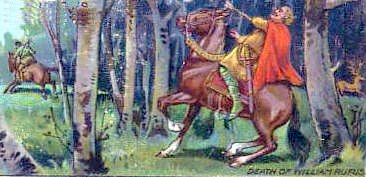
Enough of that! Let's get to the subject of William's curious death while hunting. It's fair to say that, since 1066, a decent number of kings have died violently in one way or another. But once you rule out battle (Richard I and III), execution (Charles I) and deposition (Edward II, Richard II, Henry VI and Edward V), then William Rufus seems to be the only case I can call to mind of a king of England who was killed by accident - or was he? Are we dealing with a fatal accident or a deadly conspiracy?
On the day in question, William was in fine fettle; he loved hunting above all else. In terms of his choice of royal day-out it was the best larks evs. Also in his party were a number of other nobles, key amongst whom were: his younger brother, Henry (Aha! He's back!), the brothers Gilbert and Roger de Clare and Walter Tirel who was Lord of Poix in Ponthieu and brother-in-law to the de Clares. Shortly before they set off, a letter from the Abbot of Gloucester was delivered which warned of a monk who'd had a vision of the king's death. William, however, scoffed at the nonsensical "dreams of snoring monks" and rode off into the forest.
As the story goes, the party became separated as the chase got underway, Rufus and Tirel finding themselves alone. Startled by a stag that came out of nowhere, Tirel supposedly loosed an arrow which missed, deflected off an oak tree and struck the king in his chest, piercing his lung. What happened next is what has given rise to claims of a conspiracy. First of all, Tirel immediately fled overseas. Was this because he was worried he might be punished for his negligence or rather because he had been paid to carry out the evil deed and needed to make himself scarce? You ain't seen me, right? Either way, he was supposed to be an accomplished bowman so it is doubtful that he would be so rash as to take such a risky shot. That said, hunting accidents were not uncommon; remember William's own brother had died twenty-five years earlier in the same forest.
More telling, though, is the behaviour of Henry. Rather than care for his wounded brother or oversee the transport of his body to nearby Winchester, he chose instead to abandon Rufus and ride with all speed to Winchester where he seized the treasury. A day later he had himself elected king and was crowned two days later in Westminster Abbey before either Archbishop could arrive. Why the haste if this was not a premeditated plan? Seizing the treasury so quickly is particularly telling as possession of the royal coffers effectively conferred power onto the person who held them.
Once Henry was king (Henry I for those that worry about such things), he was at pains to lavish favour on the de Clare brothers. Perhaps this was reward for their support in the conspiracy?
So what of William Rufus? His body lay abandoned while everyone else rushed off to secure their positions for whatever reason. He was eventually found by a charcoal burner named Purkiss, who unceremoniously dumped the body in the back of his cart and took it to Winchester where the king was hastily buried beneath the tower. That the tower then collapsed a few years later was taken as a sign - by the church - that he was ill-favoured by God due to the evil actions during his reign. His death, to them, was quite simply an act of God and nothing more than he deserved.
Sunday, 8 January 2017
The White Ship: a 12th century succession crisis.
It is one of the greatest naval disasters in the history of
these British Isles but one that few people have heard ever of. One seemingly small event on a foul day in
November 1120 was to cause a crisis in the royal succession and lead to a civil
war that was comparable in impact to its more famous successors in the
fifteenth and seventeenth centuries.
As the Chronicler, William of Malmesbury wrote: ‘No ship
ever brought so much misery to England’.
So what happened? The king at the time – Henry I, fourth son
of William the Conqueror – had been in Normandy to deal with a dispute over the
title to the Duchy that had been raging with Louis VI of France since 1115.
Peace had finally been achieved with the help of Pope Callixtus II and now
Henry was preparing to sail back to England with his only son and heir, William
Adelin.
(NB. Regular readers of this blog may recognise a similarity
with the Saxon word Aetheling, meaning prince of the royal dynasty, as in Edgar
Aetheling who was briefly acclaimed King by the Saxons after the death of
Harold II at Hastings. Adelin is the Norman spelling of the word and an attempt
to show continuity with the former Saxon rulers; a union of old and new, if you
will.)
Henry and William arrived at the port of Barfleur where they
were met by a ship’s captain, Thomas FitzStephen, who offered his newly
refitted, state of the art vessel – the White Ship – to convey the king back to
England. Thomas was a man of some renown as he was the son of Stephen
FitzAirard who had captained the Mora in 1066; the ship that had carried Duke William
to England to launch his invasion.
Despite these impressive credentials, King Henry demurred.
He had already made his travel plans and no doubt he preferred his trusty old
ship rather than any new-fangled, modern nonsense. Nonetheless, he did allow
his son and his retinue (including two of the king’s illegitimate children:
Robert of Lincoln and Matilda FitzRoy) to avail themselves of Thomas
FitzStephen’s offer.
That is when the drinking started. William was 17 at the
time and, like many teenagers suddenly free of the shackles of an overbearing
father, he saw the opportunity for a party with his mates. The wine flowed in
copious quantities and by the time the ship set sail that night, over 300
people were on board, most of whom would have been roaring drunk; including the
ship’s captain.
Whether it was William himself or one of his friends that
put him up to it is not known, but – full of drunken bravado – they ordered the
captain to show them what the ship could do, challenging him to overtake his
father (who had left port several hours earlier) and to reach England before
him. No doubt William pictured himself standing smugly at the docks in Southampton
or wherever, casually waving as his father eventually arrived, shouting “What
took you so long?”
However, the harbour of Barfleur is difficult to navigate at
the best of times but in the dark and with the crew several sheets to the wind,
it was a recipe for disaster. In order to gain time on the rest of the royal
fleet, they dispensed with following the safe route and instead went full pelt
in the most direct route possible. Disaster struck not far out to sea, when the
hull struck a submerged rock, ripping a huge gash in the timbers.
It would appear that not everyone was completely trousered,
however, as members of William’s household did manage to bundle the prince into
a small dinghy and get him away from the floundering ship. Everything might
have been well were it not for the fact that William was said to have heard the
cries of his half-sister who was still on the White Ship. William gallantly ordered
the dinghy back to rescue her and it is ironic that such a noble action was to
seal his fate. By now there were so many people in the freezing waters of the
Channel that there was a mad scramble to reach the dinghy, the result of which
was that the little boat was swamped. It capsized and sank without trace,
taking the heir to the throne of England and Normandy with it. For months
after, finely dressed bodies were washed up all along the shoreline, but no
race was ever found of William Adelin.
Impact
So why did the loss of this one ship have such a huge
impact? Well, never was the phrase ‘Heir and a spare’ more apt. Despite having numerous
illegitimate children, William was Henry’s only surviving male heir. His only
other legitimate offspring was his daughter, Mathilda (also sometimes known as
Maud), and in these unenlightened times, no one was quite ready for England to
be ruled by a woman.
The death of William therefore caused a succession crisis.
Although Henry married again and was to reign for another 15 years, he did not
produce any more legitimate children. On his death in 1135, therefore, England was
plunged into a period of civil war – known as the Anarchy – that was not fully
resolved until Mathilda’s son, Henry II, acceded in 1154 (him of Thomas a
Becket fame).
Henry I did nominate his daughter as his successor and made
his nobles swear an oath of allegiance to her but, with him gone, they weren’t
inclined to make good on that vow. Mathilda, together with her husband,
Geoffrey of Anjou, tried to take the throne as planned but they were met with
resistance from the Norman barons who, instead, favoured her cousin (and Henry
I’s nephew), Stephen of Blois, who was to become King Stephen.
Mathilda did actually defeat and capture Stephen at the
Battle of Lincoln in 1141 but her attempted coronation at Westminster Abbey
collapsed in the face of bitter protests from the London crowds. Then, as now,
there were those who would rather anyone other than a woman be in charge.
Thereafter an uneasy stalemate ensued with many twists and
turns until a point was reached whereby the future Henry II acknowledged
Stephen as the rightful king was in return was adopted as Stephen’s son and
successor. Although Mathilda had failed to become Queen in her own right, she
had at least managed to secure the succession for her son. A great grandson of
William the Conqueror would carry on the line.
Friday, 16 December 2016
Decimation - not as bad as you might think?
Decimation - if you were to look it up in the dictionary you might
find words to the effect of "to destroy or
kill a large proportion of (e.g. a plague decimated the population)". In the Thesaurus you
will find synonyms such as 'annihilation', ' cataclysm' or 'devastation'; all
of which sounds pretty apocalyptic. But was it always this way? Has modern
usage assigned a meaning that is far bigger than the original intent?
Well
- the short answer is "yes", but when was there ever any fun in
giving a short answer when you have a long one to hand, as it were.
The
word decimation - as you might not be surprised to learn - originates from the Latin
for ten (i.e. decem). In its original form, decimation was a form of punishment
used to instill discipline within the Roman Army from the fifth century BC
until the early Imperial times of the first century AD, and which even made the
odd appearance in much later times - but more of that later.
So
what was decimation all about? Well, in essence it was a spectacularly brutal
exercise that must have been an incredibly effective deterrent to any unit that
was considering desertion in the heat of battle or mutiny against their
commanding officers.
In
summary, the procedure - once enacted - was as follows: a cohort (typically
around 480 men) was divided into groups of ten. Each group then drew lots with
the loser then being executed by the other nine - usually by means of stoning
or clubbing to death.
Watching
someone being executed by means of a hangman or similar must have been bad
enough, but actually having to do the killing yourself must have been
horrendous. The poor sod who drew the short straw might well be your best
friend - someone with whom you had joined up many years before, trained with,
fought with, perhaps even saved your life on occasion. At the very least it
would be someone you shared a tent or barracks-room with. Someone with whom you
had forged an incredibly strong bond of trust and loyalty. And now you had to
crush his skull with a rock.
For
the rest of the unit, that was not the end of the matter, though their fate was
by no means as bad. They were made to live off barley instead of wheat rations
and forced to camp outside the walls of the fort for a few days which, if on
campaign, must have carried its own dangers.
I
can well imagine that the threat of this punishment must have gone a long way
to keeping legionaries in line when it came to facing down overwhelming odds in
battle. Better to fight and die with honour than live with disgrace and the
threat of decimation.
How
often was it used? Not very, in a nutshell. The earliest recorded instance
occurred in 471 BC where, after the army had been scattered by the Volsci
tribe, the consul of Rome ordered that the officers who had thrown away their
weapons would be whipped and beheaded and that the rank and file would be
decimated.
Another
example occurred during the Third Servile War in 71 BC (cue cries of "I'm
Spartacus and so's my wife".... er.... hang on). Following early victories
for Kirk Douglas' slave army, the Roman Commander - Marcus Licinius Crassus -
dished out the punishment to which a number of contemporary historians then
attributed his subsequent success. Hollywood left that bit out of the film,
though I don't know why as it would have added to the drama quite nicely.
Although the
practice was eventually outlawed in the later Roman Empire, there have been a
few recorded instances in more recent times. For example, in 1642 during the
Thirty Years' War, Colonel Madlon's cavalry regiment (of the Holy Roman Empire)
fled the Battle of Breitenfeld (near Leipzig) without a shot being fired.
Afterwards the commander, Arch-Duke Leopold of Austria, erased the regiment
from official lists, condemned the officers to be beheaded and 90 of the the
soldiers were decimated with the survivors being discharged from the army.
So
whilst decimation only really meant that 1 in 10 were actually killed, the
impact on those involved must have felt pretty cataclysmic all the same.
Subscribe to:
Posts (Atom)